

How the farm uses its Kirkmayer® ECA System Generator

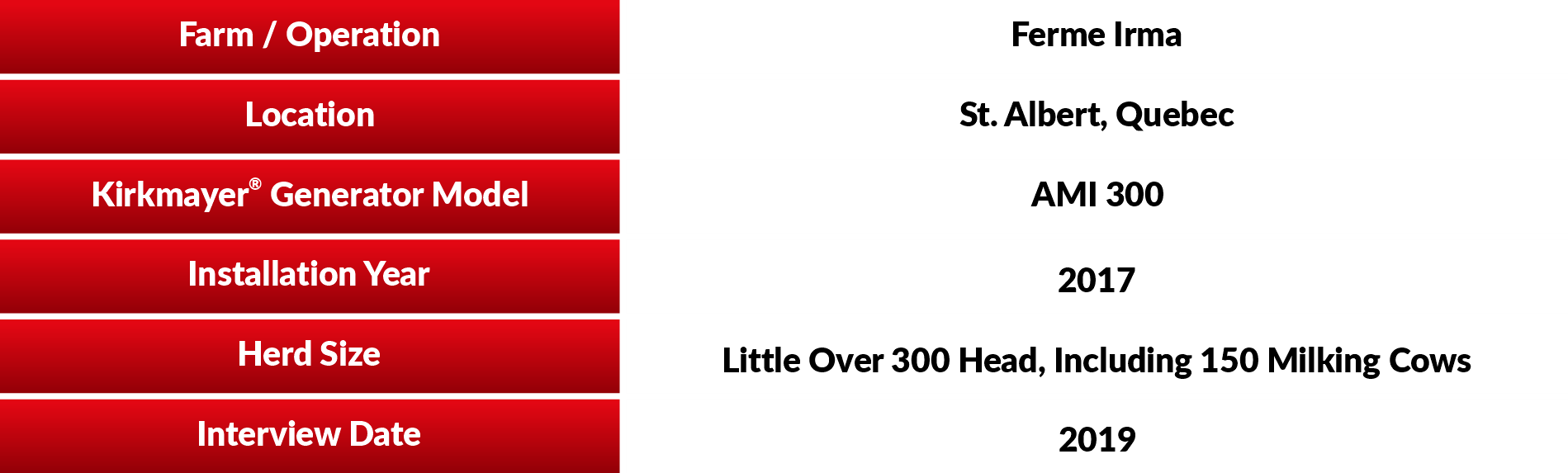
Farm & System Profile
Kirkmayer® AMI 300 ECA System Generator
ABOUT THIS FEEDBACK: The responses below summarize one dairy farmer’s reported operating practices and observations. Results are farm-specific and are not presented as universally validated protocols.
1 | Drinking Water Management
QUESTION: What Anolyte dosing rate is injected into the drinking water?
FARMER RESPONSE: We currently inject Anolyte at a 1.4% dosing rate. The Anolyte is produced at 500 ppm, with the objective of achieving an ORP of approximately 700 mV at the final watering trough or at the end of the water line.
QUESTION: What are the pH and ORP of the Anolyte before it is injected into the drinking water?
FARMER RESPONSE: The Anolyte is produced at approximately pH 5.8 with an ORP of 950+ mV.
2 | Teat and Hoof Hygiene
QUESTION: Is Anolyte used for teat washing? If so, at what concentration and pH?
FARMER RESPONSE: Yes. We use Anolyte at 500 ppm and pH 5.8, with 10% glycerin added.
QUESTION: Is Anolyte used in a footbath? If so, how is it used?
FARMER RESPONSE: We use Anolyte in the footbath for maintenance. When the bath becomes heavily contaminated with manure, we find that its effectiveness declines. In our tie-stall barns, we achieved excellent farmer-reported results by spraying undiluted, generator-produced Anolyte directly onto the hooves.
Important note: Footbath and direct-hoof protocols should be validated with the herd veterinarian, including concentration, contact time, organic-load management, animal suitability and local requirements.
3 | Milk-Line and Equipment Cleaning
QUESTION: Is Catholyte used to clean equipment such as milk lines? What dosing rates are used?
FARMER RESPONSE: We use Catholyte for milk-line washing at a 1:28 dosing rate. At this rate, we report achieving approximately 500 ppm alkalinity. For disinfection, we use Anolyte at a 1:2.5 dosing rate, diluting Anolyte produced at 500 ppm to achieve approximately 200 ppm. Under our farm procedure, this concentration is used as a no-rinse disinfection step, subject to local requirements.
QUESTION: How long does the equipment washing process take, and what is used for rinsing?
FARMER RESPONSE: The cycle takes approximately the same amount of time as the farm’s normal procedure with other products. Water temperature and rinse requirements are managed according to the farm’s standard process and Quebec regulations.
4 | Barn and Calf-Nursery Biosecurity
QUESTION: Do you fog Anolyte in barns? What concentration and equipment are used?
FARMER RESPONSE: We fog the calf nursery once a week using generator-produced Anolyte at 500 ppm and pH 5.8. We apply it with a Stihl backpack sprayer configured for fogging. The farm uses this practice as part of its environmental pathogen-pressure program, including its management of Cryptosporidium risk.
Important note: Fogging procedures should be validated for equipment, droplet size, ventilation, exposure, concentration and contact time. Follow veterinary guidance, product directions and local regulations.
QUESTION: Has using Anolyte reduced medications previously required to maintain animal health?
FARMER RESPONSE: We have observed reduced environmental bacterial pressure in the water and on hard surfaces, as well as reduced biofilm that can harbour pathogens. We also report lower medication costs and a substantial reduction in veterinary costs.
QUESTION: Do you dose Anolyte into milk for nursing calves?
FARMER RESPONSE: The farm has trialled a 10% dosing rate in calf milk and believes it may contribute to milk stability. However, the farmer specifically notes that this use is not promoted because the benefit is difficult to substantiate.
Important note: Do not add Anolyte to milk or animal feed without a veterinarian-approved, validated protocol and confirmation of all applicable feed, milk-residue and local regulatory requirements.
5 | Direct Application and Herd Observations
QUESTION: Have you sprayed or applied Anolyte directly to animals?
FARMER RESPONSE: The farm reports using a wet spray directly on animals without observed harm. It has also used Anolyte as part of its care process for minor cuts and abrasions and reports positive outcomes.
Important note: Direct-animal and wound-care uses require veterinary guidance and a validated protocol. This feedback is not a treatment recommendation.
QUESTION: Have you observed improvements in overall animal health and the nursery?
FARMER RESPONSE: Yes. We report better overall animal health, reduced medication costs and a significant decline in veterinary costs.
6 | Overall Experience and Additional Uses
QUESTION: How long has the farm been using Anolyte and Catholyte?
FARMER RESPONSE: We installed our on-site Kirkmayer ECA System Generator in 2017 and found the results amazing.
QUESTION: What other improvements have you observed?
FARMER RESPONSE: The most significant improvement has been better overall animal health.
QUESTION: Have you found other useful applications on the farm?
FARMER RESPONSE: Yes. We have found the solutions useful for silage treatment before covering with a plastic tarp and for seed treatment.
Important note: Agricultural applications should be validated for the specific crop, silage process, concentration, contact time and applicable regulations.
Farmer-reported Takeaway
The system supports multiple on-farm applications from water management and milk-line cleaning to teat hygiene, hoof-care maintenance and calf-nursery sanitation – all produced on-site and on demand.
Responsible-use Statement
Farmer-reported practices and results may vary. Validate solution chemistry, concentration, contact time, materials compatibility, worker and animal exposure, veterinary suitability, milk/food residue requirements and local regulations before adopting any protocol.